Alberta Review: Alberta's Literary Form
Alberta doesn't have a defining novelist or novel. Instead, we have the short story.
The best and fastest way for this to grow is for you to share the posts within your networks. A forward goes a long way, and the more subscribers we get, the more I’ll be able to write. The writing may change in the next few months to be a bit more entertaining (we hope) so tell your friends!
I haven’t been able to write for a while, and for that I apologize (and I am fully aware and lament the reality that the reality is I write in spirts, determined by how busy I am at my day job). The more recent problem, though, is that I haven’t really read anything sufficiently related or relatable to Alberta. It’s been a lot of bad fiction, some seriously good short fiction, and a lot of short story collections.
I’ve become a bit obsessed with short stories lately, both because they fit quite well into my life right now and because they are an art form I’ve largely ignored before now. I’ve read a lot of sci-fi—the “key mode of short story in the twentieth century”—and also some crime fiction. I also read the original Wizard of Oz, which is short, although not generally considered a short story, and is the only true North American fairy tale. The Wizard of Oz is also a quintessentially prairie story.
And that’s when I found my angle; Alberta is a landscape and culture tailor-made for the short story.
Our literary history centres around the short story writer. We don’t have a great novel, nor do we have a great novelist, in the traditional sense. Many nations have a novelist. Dostoyevsky, Cervantes, Twain, or Marquez. These writers define a people, a landscape, or at the very least a particular aspect of those people at a particular point in time. Alberta’s most read writers were short story specialists; both R. Ross Arnett and W.O. Mitchell excelled at the short story (Jake and the Kid is essentially a collection of short stories, rather than a single narrative) and W.P. Kinsella is one of Alberta’s most celebrated writers (although best known for his novel, Shoeless Joe). Additionally, our best-selling novelists are often sci-fi writers, reflecting a settler-society obsession with expansion into the unknown. And, as I said, sci-fi’s roots are in the short story.
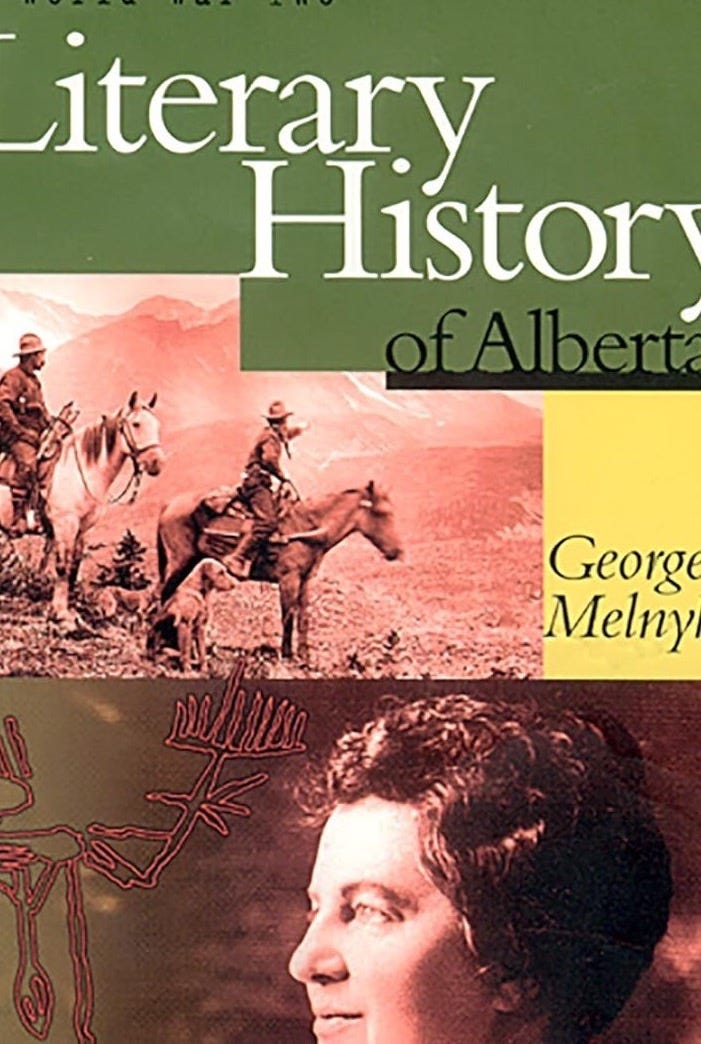
It is not novel to tie a literary form to a national identity. Joyce Carol Oates called the short story the “blessed Irish genre,” with class dynamics in Ireland being more relevant to the style. In his first volume of the Literary History of Alberta George Melnyk argued that:
“…writers from the forgotten underpinning of our cultural consciousness. As a determining factor in Alberta’s identity, they too are acknowledged more by thier absence than by their presence. Writers and their books were an integral part of defining the geophysical and social space that is now Alberta, but many of them have since been relegated to obscure and specialized interests.”
Meanwhile, the English produced fewer short story writers and more novelists; the rich had more time to be introspective, perfect for the novel, and big stories were told by a big empire. On it’s surface, Alberta should be a province of novels. It is a “place of meeting, of colliding contrasts, of differences articulated.”1
The short story is a story of a single incident, and Alberta is a province built more on single incidents—Leduc No. 1, the NEP—and political dynasties, not intricate, long-running tales woven between generations. Not that those don’t exist, just that the stories we tend to tell ourselves are more single-faceted. We’re also more individualist, by stereotype, and to this day emphasize work over play, leaving less time for long-form reading. Our publications of note in the formation of a provincial identity were agricultural magazines, where the short story dominated.
Unfortunately, the short story as a literary form is in decline, one that mirrors, mostly, the decline of print magazine readership. The short story’s rise coincided with the 19th-century proliferation of magazines, and maybe that’s one reason it can be tied to the province, with our rise mirroring the short story’s. It does seem perfect for the energy of a growing province: “Readers and publishers alike were avid for lively incident that could be compressed into the short space of one or more columns on a page.” It was a popular—and populist—form of storytelling. It was looked down upon by more “literary” and elite readers in more established places of learning and refined kinds of commerce. Alice Munro, the Ontarian short story writer (and only author to be awarded a Nobel Prize in Literature for short stories alone), said they were hard work, harder than novels. The form is a concise, impressive effort to accomplish a significant task in a short period of time.
That element of being more populist is tied to the reality of Alberta as an identity. Our early literary identity was the same as our general one: “As a hinterland province, Alberta has had a hinterland literary identity,” Melnyk writes. Alberta’s literary history begins, he says, with an oral tradition that originated with the Indigenous people, but can also be extrapolated to a settler society that came from many different cultures, speaking many different languages. Oral traditions, especially stories, are generally more akin to a short story than a novel, typically featuring a singular, straightforward narrative with few side plots or intricacies.
Added up, do these not describe Albertans’ sense of self? Looked down upon by an eastern elite, more populist than our contemporaries, prepared to work hard for a single reward? The short story in no way dominates Alberta’s literary scene today, not from a popular perspective at least. They exist, but few Albertans will read them. That is true for short stories almost everywhere, though that is slowly changing as the novel loses adherents (and the public loses thier attention spans).
In the modern literary world, regional literary types are becoming increasingly rare. As the world globalizes, so does writing. Some stories are set in a particular place, and the good ones will properly convey the culture of that place, but a geographically centred literary tradition, in which every story reflects a geography, is dying a quick death.
That all being said, a literary form can still speak more to a place, regardless of who writes it, where they’re from, and what it’s about. And, for Alberta, it is a land of short stories where the land—and people–are tailor-made for the format.
Alberta Review relies on subscriptions to operate (we hate ads, and they’re kind of pointless). Please consider subscribing to support the publication.
Alberta Review is in no way associated with previous iterations of the publication Alberta Review.
Robert Kroetsch, quoted in Literary History of Alberta: Volume One.