
Alberta Review: The Power of Art and Culture
"Our brains need literature the way that our bodies need food. Literature provides our brains with basic sustenance."

The best and fastest way for this to grow is for you to share the posts within your networks. A forward goes a long way, and the more subscribers we get, the more I’ll be able to write. The writing may change in the next few months to be a bit more entertaining (we hope) so tell your friends!
Everyone’s algorithm is different, or at least I assume it is. Either way, mine shows me a lot of hard takes on AI. I see lots of academic studies showing that it doesn’t actually make workers more productive, burns people out, makes it harder to learn new skills, or makes people dumber. Although it does seem weird that we needed a study to show that outsourcing thinking to a machine would cause skills to atrophy. Something something, common sense not being that common, or something.
My algorithm, though, also shows me a lot of the other side—these things are good! They’re inevitable! If you don’t embrace the suck, you’ll be left behind. It costs a lot of water and money to raise an intelligent human, too!
That all being said, AI in the workplace is one thing. That is, likely, inevitable, although there’s a lot left to be decided, from what jobs it will actually make easier, which ones it will eliminate, and which ones it will just make worse. But as video and image generators become “better,” the more pronouncements there are that artists have no place in society. Or, at least, not without AI help.
This, though, is proving to be an unpopular concept, as more and more people turn against mass AI implementation. A recent NBC poll found that 57 per cent of Americans believe the risks of AI outweigh the benefits. When it comes to art, a poll published in an article in Scientific American was even more stark:
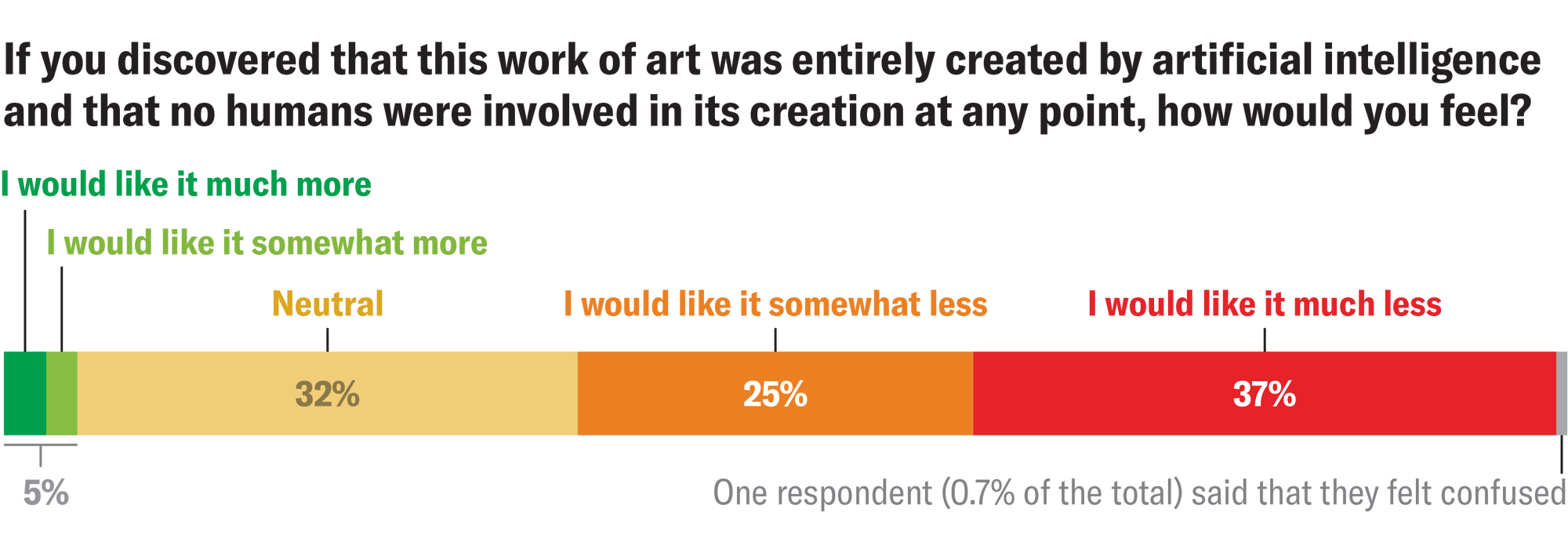
Closer to home and much more recent, Calgary Public Library took significant criticism for announcing an AI artist-in-residence program. Things like this are especially gaulling to artists because there is no actual creativity in what AI produces. It merely steals from artists and reproduces their work. It’s like being hired at a job to train the guy who will replace you.
I don’t think it is a profound or revelatory thing to say, but maybe it will be. AI art aside, we’re suffering a crisis of the soul in the Western world right now. From polarized politics to economic malaise and social isolation, we’re in a bit of a slump. I read two books over the last month that articulated clearly that the solution is more humanity and, specifically, more artistry.
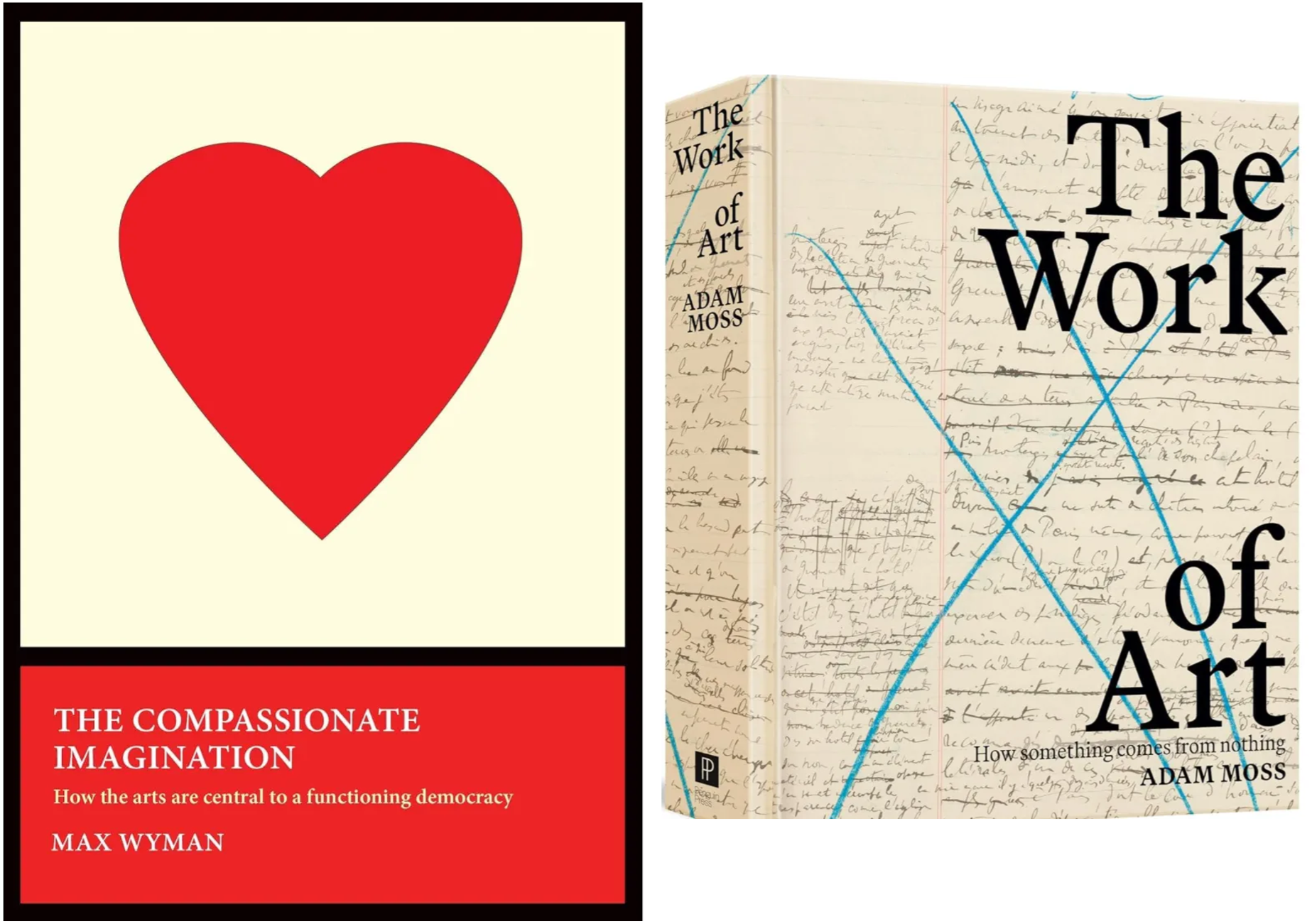
The Compassionate Imagination argues for a renewed Canadian cultural contract, where the arts are recentered in policy making, because, without the arts, we lose our connections to each other and to our humanity. The book presents few new ideas—artistic creations force us to think about other people and perspectives, creating empathy—but does present some bold ideas when it comes to arts advocacy. Wyman says that it is wrong to try and argue for more support for culture from government and the public because of economic benefits (although they are quite large) because this minimizes the importance arts and culture have for the souls not just of individuals but our nation. Human fulfilment, he argues, should trump market economics. In the age of AI, this seems more true than ever before.
Wyman’s focus on art’s role in creating empathy and creative thought is the core of his argument that centreing art in our policy-making and society would lead to a better democracy (although he does not make this argument explicitly, and so the subtitle of the book, “how the arts are central to a functioning democracy,” is a bit odd and a glaring omission). Since it was written in 2023, it’s become even more clear. Our souls are hurting, and our political discourse would be so much better if people read a book or watched a movie without interruption or went to a play instead of being on social media. We need something to fulfill us, and art plays that role.
The second book, The Work of Art, is a series of profiles of artists’ great works and how they came to develop them; it is a clear argument that process matters as much as product when it comes to art. In the author’s words, it is “the celebration of the art that happens when instinct meets rigor.” Toiling, thinking, developing, researching. The profiles makes it clear that these things cannot be disconnected from the final end product. It is, without ever saying, a clear refutation of AI produced art. The act of creation is embodied in the final product. The arduous nature developing the kernel of an idea into a great work is what makes the work great. To think that nothing is lost when you prompt an AI is to laugh in the face of artistic creation, and common sense. While that’s the message I got, the book itself is just a massively inspiring, but also frustrating (why can’t I do that!) piece of biography.
If these books made me realize one thing, its this: we talk a lot about AI doing art these days, and, anyone who thinks that is good or even acceptable, simply doesn’t care about art. Because art is process, connection, craft. Humans created pretty things before we built houses, before we farmed, before we built civilization. Making art, creating culture, is at the very core of being human. If you take the human out of it, you take the humanity out of everything.
Alberta once obsessed over supporting the arts. Part of this was because we had a chip on our shoulder, always assuming (probably correctly) that we were looked down upon by the more “cultured” east. One of the best books to read on this is Alberta’s Camelot about the Lougheed government’s obsession with building Alberta’s creative capacity and cultural institutions. Budget 2026 increased funding for the Alberta Foundation for the Arts, which, when everywhere else other than education and health care was cut, was a pretty nice surprise.
More, of course, could be done. Wyman argues for much more financial support for artists, including a type of universal basic income to empower creation. That’s honestly not a bad idea (although the mechanics of it, like who is an artist and who can qualify, would likely be discountingly hard), but at the very least, there should be more emphasis on appreciating art in schools so that greater demand is created, making the economics more lucrative. At least, that’s one possible step.
More than anything, though, there needs to be a societal decision to emphasize that human-created art is good. Full stop. Whether it’s a piece of literary fiction or a popular movie, art enhances our lives because of the human element, not despite it. Teach that in schools, please.
Alberta Review relies on subscriptions to operate (we hate ads, and they’re kind of pointless). Please consider subscribing to support the publication.
Alberta Review is in no way associated with previous iterations of the publication Alberta Review.